Configure File Manager
N1ED browses, uploads and edits images with the Flmngr file manager. Its settings are in the File Manager section of your Dashboard's Settings tab, in the same order as on this page. Most of them are part of the Premium plan: on other API keys you can see them but not change them.
Link file manager with the server
Two URLs connect N1ED to your file storage: the File Manager URL, where the Flmngr backend you installed on your server answers, and the Files URL, the public address of the folder it manages, from which N1ED builds the links to your files. Set both in the Server row.
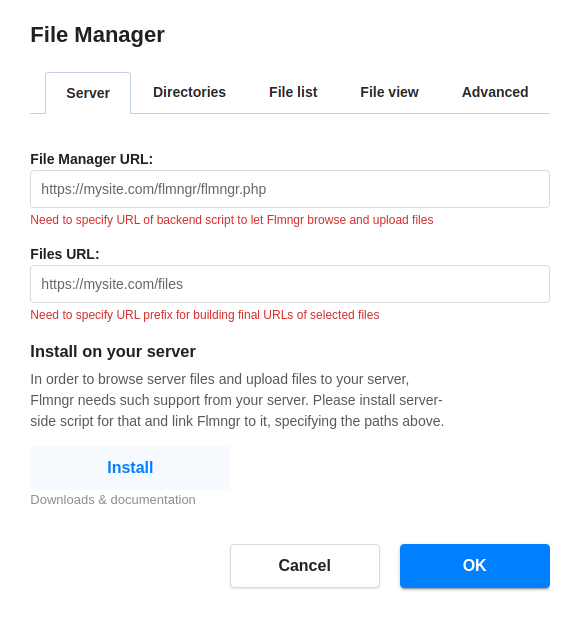
Until you set them, N1ED uses our public demo file server, which is for trying N1ED out and not for your real files. Please review the File manager installation manual to set up the file manager on the server side if you haven't done so already.
If your server asks for a login (HTTP Basic Auth), fill in User and Password too, and every request of the file manager carries them. Keep in mind that the configuration of an API key is sent to every browser that opens your editor, so anyone who can open the editor page can read this password. Use it only to keep robots out, never for an account that protects anything else.
With a CMS module (Drupal, Joomla and others), the module tells N1ED where its file manager is, so these fields are locked in the Dashboard.
Directories settings
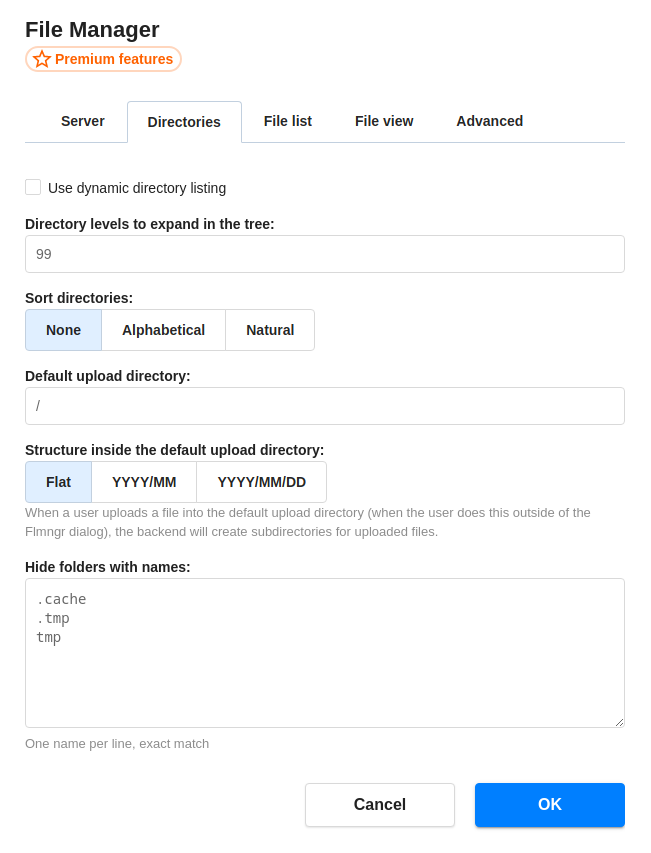
The Directories and Uploads rows control the folder tree on the left of the file manager, and where files go when they are uploaded without opening it.
Available options
- Auto expand tree levels: how many levels of the folder tree are open when the file manager starts. The folder of the file you are editing is always open.
- Preload auto expanded directories only: instead of fetching the whole folder tree at once, the file manager loads the first level of folders, and the folders inside each one when you open it. Use it for storages with many folders. Search only looks through the folders loaded so far.
- Sort directories: None keeps the order your server returns, Alphabetical sorts by name character by character, Natural sorts numbers the way people do ("9" before "10") and ignores letter case.
- Hide folders with names: one name per line. Folders with exactly that name (letter case matters) are not shown in the tree, at any depth. This hides them from view only: the folders are still there and search still looks into them.
- Default upload directory: the folder, relative to your storage root, for uploads made without opening the file manager: files dropped or pasted into the editor, and the Upload button. Uploads made in the file manager itself go to the folder that is open there.
- Uploads hierarchy: adds date folders inside the default upload directory, from the date of the upload:
yyyy/mmgives/2026/09/,yyyy/mm/ddgives/2026/09/5/(the day has no leading zero). The folders are created on the first upload.
File list settings
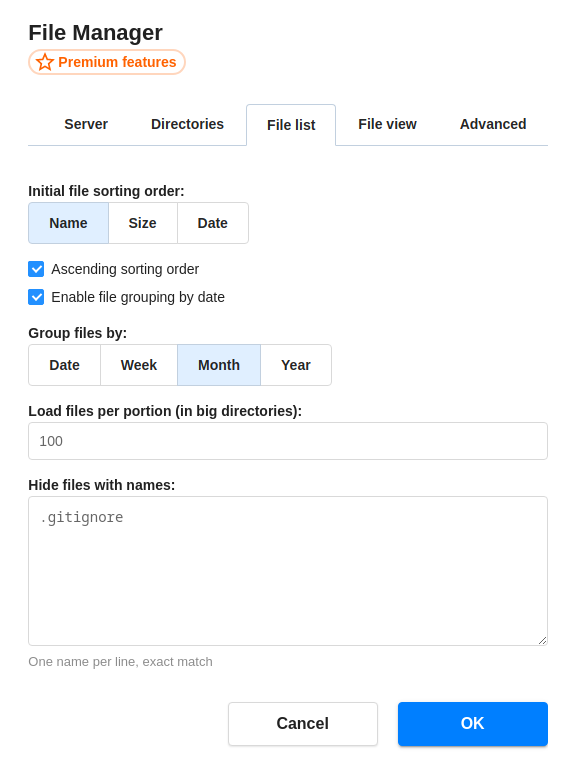
The File list row sets how the files of the open folder are listed.
Available options
- Load on scroll: the file manager lists a big folder in portions of this many files and loads the next one when you scroll to the end.
- Initial file sorting order: by Name, Size or Date. Users can still change it in the file manager.
- Ascending sorting order: uncheck it for Descending.
- Enable file grouping by date: puts a header over the files of each period while the list is sorted by date.
- Group files by: the period for those headers: Date (today, yesterday, then each day), Week, Month or Year.
- Hide files with names: one name per line, for example
.gitignore. With our PHP backend a line can be a pattern:*.loghides every log file, and letter case does not matter. Hidden files are left out of search results too.
File view settings
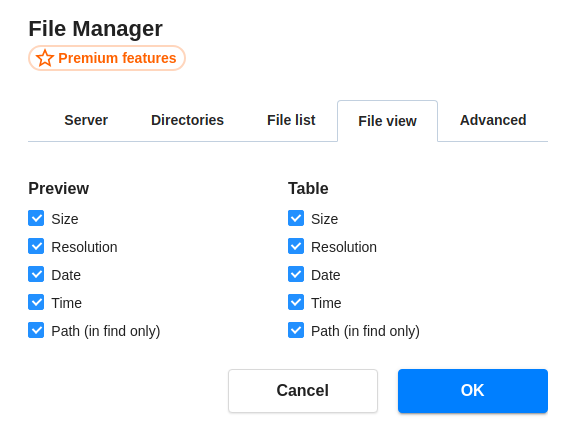
The file manager shows a folder as previews or as a table. The File view row picks what each of the two shows under a file: its size, the resolution of an image, the date and the time it was changed, and its folder, which is shown in search results only.
Stock images
The file manager can search free photos on Unsplash and add the one you pick to the open folder: the Get from stock button on its toolbar. It needs your own Unsplash access key in the Stock images row. How to get an Unsplash access key.

Advanced settings
The Advanced row has two options, and the login for your server is in the Server row (see Link file manager with the server).
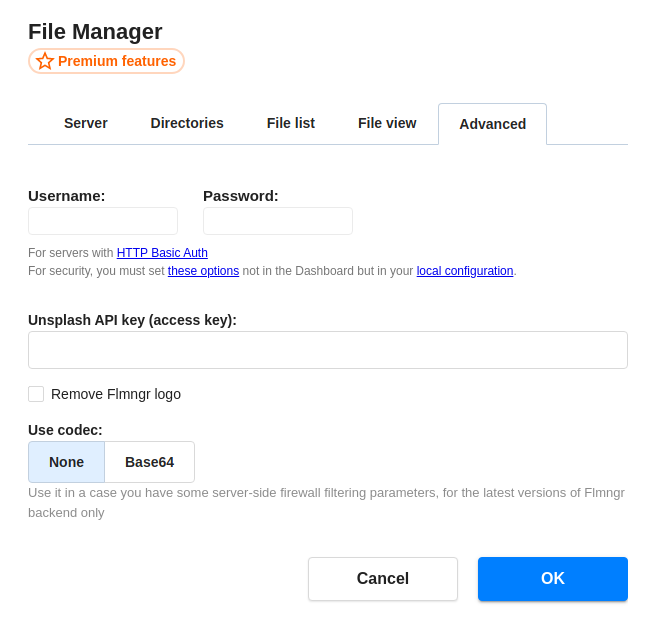
Available options
- Set username and password: for servers with HTTP Basic Auth, in the Server row now.
- Unsplash API key: has its own Stock images row now, see Stock images.
- Remove Flmngr link: hides the bar at the bottom of the file manager with the Flmngr logo and the help link.
- Use codec to get through a firewall: Base64 encodes the values of every request to your server, for firewalls that block requests with paths or HTML in them. Your backend has to decode them: our PHP backend does.
Configuration parameters
Each setting above is a key in the configuration of your API key. You can also set it in the editor's own config for a particular page or user, see Dynamic config. A value set there overrides the Dashboard.
File Manager URL
URL of the Flmngr backend on your server.
Flmngr.urlFileManagerstringhttps://flmngr.democdn.com/file-manager-defaultMore info in the installation manual. A top-level urlFileManager key from older configs is still used while this one is empty or the default.
User
User name for accessing the file manager. Use it only if your server requires Basic Auth.
Flmngr.urlFileManager__userstringnullPassword
Password for accessing the file manager. Use it only if your server requires Basic Auth, and remember that it is readable by anyone who can open the editor page.
Flmngr.urlFileManager__passwordstringnullFiles URL
URL prefix of the files on your server: the public address of the storage root.
Flmngr.urlFilesstringhttps://flmngr.democdn.com/files/defaultMore info in the installation manual. A top-level urlFiles key from older configs is still used while this one is empty or the default.
Uploads directory
The default directory for uploads made outside the file manager, relative to your storage root.
Flmngr.defaultUploadDirstring/More info in the installation manual. A top-level dirUploads key from older configs is still used while this one is /.
Uploads hierarchy
Date folders to create inside the default upload directory.
Flmngr.defaultUploadDirStructurestringflatflat, YYYY/mm, YYYY/mm/ddAuto expand tree levels
How many levels of the folder tree are open when the file manager starts.
Flmngr.expandLevelsnumber99Preload auto expanded directories only
Load the folder tree level by level instead of all at once.
Flmngr.isDynamicDirListingbooleanfalseSort directories
The order of the folders in the tree.
Flmngr.sortDirsstringnonenone, alphabetical, naturalHide folders with names
List of folder names to hide in the tree: exact names, letter case matters.
Flmngr.hideDirsstring[][".cache", ".tmp", "tmp"]Hide files with names
List of file names to hide in the list and in search results. With our PHP backend the names can be patterns (*.log) and letter case does not matter.
Flmngr.hideFilesstring[][".gitignore"]Load on scroll
How many files to load at a time in a big folder.
Flmngr.filesPerPortionnumber100Initial file sorting order
Flmngr.orderBystringnamename, size, dateFlmngr.orderAscbooleantrueFile grouping by date
Headers over the files of each period, while the list is sorted by date.
Flmngr.enableFileGroupingbooleanfalseFlmngr.groupBystringmonthdate, week, month, yearFile view
What the preview and the table views show under each file.
Flmngr.fileFields{preview: {...}, table: {...}}Each of preview and table holds five flags: size, resolution, date, time and dir (the folder of a file, shown in search results only). By default size, resolution and dir are on in both, date and time are off.
Unsplash API access key
Your Unsplash access key for the stock image search. How to get one.
Flmngr.apiKeyUnsplashstringRemove Flmngr link
Flmngr.whiteLabelbooleanfalseCodec
1 encodes the values of every request to your backend in Base64. Use the number, not a string.
Flmngr.codecnumber00, 1CSRF protection
Extra headers or parameters for every request to your backend, when your server protects its forms from CSRF. A function, an object {headers, params}, or "drupal8" for Drupal's session token.
Flmngr.urlFileManager__CSRFfunction | object | string